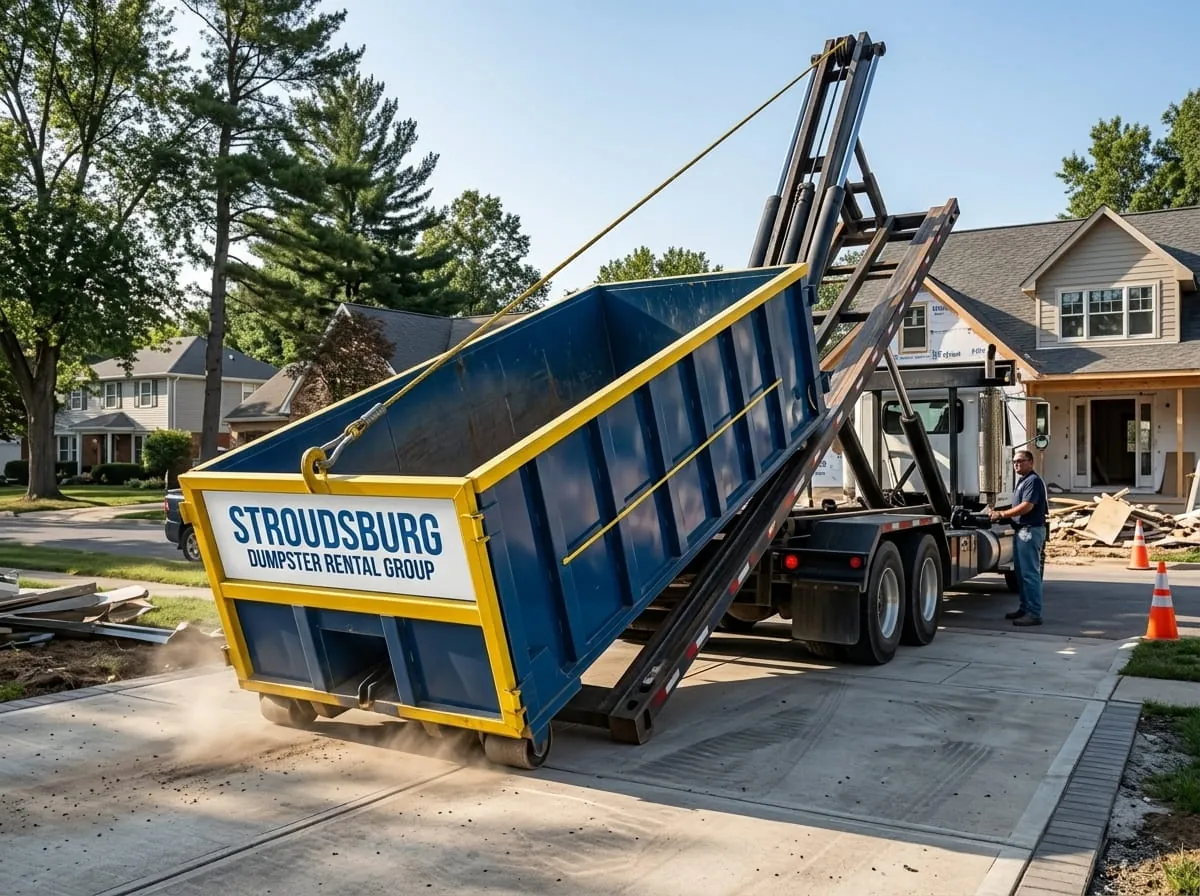
I have been loading roll-offs up and down Route 611 long enough to know that the first question almost every homeowner asks is the hardest one to answer over the phone: "What size do I need?" It sounds simple. It isn't. Order too small and you are calling me back for a second haul, paying twice, and watching your project stall while debris piles up in the driveway. Order too big and you are paying for air, plus you have a container eating your parking pad for a week longer than it needed to.
So let me walk you through how this actually works, the way I would if you flagged me down at the Weis parking lot. No sales pitch. Just the math, the traps, and a cheat sheet you can screenshot.
What a "cubic yard" actually means
Dumpsters are measured in cubic yards, not tons, and that trips people up constantly. One cubic yard is a cube three feet on every side: three feet wide, three feet deep, three feet tall. Picture your kitchen stove. Now picture roughly nine of those stacked into a block. That is about one cubic yard of space.
When I say "20 yard dumpster," I mean the container holds 20 of those cubes, or 20 cubic yards of volume. It says nothing about weight. A 20-yard box packed with couch cushions and cardboard weighs almost nothing. That same box filled halfway with wet drywall and old shingles can put a truck over its legal axle limit. Hold that thought, because the weight trap is where most people get surprised, and I will come back to it.
Volume gets you in the ballpark for how much stuff fits. Weight determines whether you blow past your included tonnage and start paying overage. You need to think about both.
The four sizes, and what each one really handles
Around here I run four workhorse sizes. Here is what actually goes in them, based on real Monroe County jobs, not a brochure.
10 yard: the small, heavy, focused job
A 10-yard box is short and low, usually around 12 to 14 feet long and about 3.5 feet tall. It holds roughly three to four pickup truck loads. It is the one people underestimate the most because it looks tiny, but it is my favorite for a specific reason: it is built for heavy, dense debris.
Think a small bathroom gut. A single-layer roof tear-off on a cabin. Busting up an old concrete patio behind a Pocono rental. Clearing out a flagstone walkway. Because concrete, dirt, brick, and shingles are so heavy, you physically cannot fill a bigger box with them without going way over weight, so the 10 keeps you honest. If your project is small in volume but dense in material, this is usually the smart, cheap call. I break down exactly what fits on our 10 yard dumpster page.
15 yard: the in-between that solves a lot of problems
The 15-yard is the size a lot of companies skip, and I think that is a mistake. It is a little longer and a little taller than the 10, holding around five truck loads. It is the sweet spot for a mid-size cleanout where the material is a mix of heavy and light: a garage that has half tools and half junk, a deck removal, a small kitchen remodel with cabinets and countertops going out.
For a lot of the vacation-rental turnovers I do up near Camelback and around Lake Naomi, the 15 is perfect. You have furniture, mattresses, some carpet, a few boxes of who-knows-what left by the last owner, but you are not tearing the house apart. It gives you breathing room over a 10 without the temptation to overload that comes with a 20.
20 yard: the all-arounder
If I had to keep only one size on the truck, it would be the 20. It is the most-rented box in the country for good reason. Roughly 22 feet long, a little over 4 feet tall, holding about eight pickup loads. It swallows a full home cleanout, a large room addition's worth of debris, flooring pulled from a whole house, or a big garage-and-basement combo.
This is the size I hand most homeowners doing a serious decluttering or a moderate renovation. It is tall enough to hold bulky furniture without wasting the footprint, but still low enough that you can toss things over the side without a strain. Full details and the load examples are on our 20 yard dumpster page.
30 yard: big renovations and whole-property jobs
The 30-yard is a wall. Around 22 feet long but roughly 6 feet tall, holding about twelve pickup loads. This is new-construction debris, a major addition, a full home gut, or clearing out an estate or a hoarder-condition property where decades of belongings have to go all at once.
Up in the Poconos I pull a lot of 30s for cabin renovations and for the big deferred-maintenance cleanouts when a mountain property finally changes hands. The one caution: the height is great for volume but it means everything goes in high. For pure heavy debris, you rarely want a 30, because you will hit the weight ceiling long before you fill it. It shines when you have a large volume of mixed, mostly light-to-medium material.
The weight-limit trap nobody warns you about
Here is the part that costs people real money. Every dumpster comes with an included weight allowance, usually measured in tons. Go over it, and you pay per ton for the excess. That overage is not a scam; it is because the landfill and the transfer station charge me by the ton, and a truck has a hard legal limit on how much it can carry down the road.
Certain materials are deceptively heavy. This is where a "bigger is safer" instinct backfires. The usual heavy hitters:
- Concrete, brick, block, and asphalt. A single cubic yard of concrete runs well over two tons. Fill a big box with it and no truck can legally lift it.
- Dirt, sod, and rock. Same story. Heavy and dense.
- Roofing shingles. A full tear-off adds up fast, especially the older multi-layer roofs on a lot of our mountain homes.
- Wet drywall and plaster. Old lath-and-plaster from a 1940s Stroudsburg house soaks up water and weight.
- Tile, wet carpet, and waterlogged anything. Moisture is pure added tonnage.
The rule I give everyone: if your debris is heavy and dense, go smaller than your gut says and fill it completely. If your debris is light and bulky, go bigger. A 10-yard box of clean concrete and a 30-yard box of packing foam can weigh nearly the same. When you call, tell me what the material actually is. That one sentence saves you more money than any coupon.
Not sure how your pile breaks down? Call me and describe it. (272) 200-0759. I have sized thousands of these and I would rather spend two minutes on the phone than have you pay for the wrong box.
How to avoid over-sizing and under-sizing
The honest truth is that most homeowners under-size. A project always generates more debris than you picture, because you are only imagining the big items. You forget the packaging, the old shelving, the stuff behind the stuff, the things you decide to throw out once you get momentum. As a rough hedge, if you are torn between two sizes and the material is light, go up one. The cost difference between a 15 and a 20 is small; the cost of a second haul is not.
The exception, again, is heavy material. There, under-sizing on volume is actually the correct move, because weight will cap you first. Do not order a 30 for a concrete driveway. You will pay for a huge box you can only fill a third of the way.
A few practical ways to get it right:
- Count your truck loads. Mentally fill a pickup bed and count how many trips it would take. Then match: 3 to 4 loads is a 10, around 5 is a 15, 8 is a 20, 12 is a 30.
- Separate heavy from light in your head. If more than a third of the pile is concrete, dirt, or shingles, size down and ask me about a dedicated heavy-debris box.
- Think about placement. Our mountain driveways are often steep, narrow, or gravel. A 30 needs room to drop and clearance overhead. If your lane is tight or tree-lined, tell me; sometimes two smaller drops beat one big one.
- Plan for the loading height. Older folks and solo cleanouts often prefer the lower 10 or 15 walls over heaving a mattress up over a 6-foot 30.
Pocono-specific stuff worth knowing
Sizing here is not the same as sizing in a flat suburb. Vacation-rental cleanouts are their own animal: a fully furnished cabin turnover produces a shocking volume of soft, bulky junk, so those trend toward the 20. Seasonal properties that have sat closed accumulate water-damaged material, which means real weight, which means size down a notch from what the volume suggests.
Cabin renovations often mix everything at once, old paneling, a torn-out kitchen, a bathroom, and a deck, and that is classic 20-or-30 territory depending on square footage. And if you are dealing with a long gravel drive off one of the back roads near Marshalls Creek or Cresco, placement matters as much as size. Send me a photo of where you want it. It is the fastest way to avoid a surprise on drop day.
The cheat sheet
- 10 yard — 3 to 4 truck loads. Small bathroom, single-layer roof, concrete, patio removal. Best for heavy, dense, focused jobs.
- 15 yard — about 5 loads. Garage cleanout, deck removal, small kitchen, vacation-rental turnover. The mixed-material sweet spot.
- 20 yard — about 8 loads. Whole-home cleanout, moderate renovation, full-house flooring. The all-arounder most people should default to.
- 30 yard — about 12 loads. Major renovation, home gut, estate or hoarder cleanout, new construction. Big volume of light-to-medium material only.
Two last rules to burn into memory. First: volume tells you what fits, weight tells you what it costs, and you have to respect both. Second: heavy material means go smaller and fill it; light material means go bigger and don't sweat it.
Still on the fence? That is normal, and it is exactly what I am here for. Tell me your project, your material, and where you want the box, and I will size it right the first time. Reach out through our contact page or just call. Getting this one decision right is the difference between a smooth weekend and a stalled mess in your driveway.

Founder, Stroudsburg Dumpster Rental Group — sharing straight advice from more than 15 years of local hauling experience.
Frequently Asked Questions
What size dumpster do I need for a whole-house cleanout?
For a full-home cleanout in the Stroudsburg area, a 20 yard dumpster is the usual right call. It holds roughly eight pickup loads, which covers furniture, boxes, and general household junk from an average home. If the property is large or crammed after years of storage, step up to a 30 yard. If you are only clearing a couple of rooms, a 15 yard is often plenty.
Why does a smaller dumpster sometimes make more sense for heavy debris?
Concrete, dirt, brick, and shingles are extremely dense. Every dumpster has a weight limit, and heavy material hits that limit long before the box looks full. If you rent a big container for concrete, you pay for space you can only fill a third of the way, then risk overage fees on top. For heavy debris, order a 10 yard and fill it completely. It is the cheaper, smarter move.
How do I know if I'm going to go over the weight limit?
Judge by material, not appearance. If more than about a third of your pile is concrete, tile, roofing, dirt, or waterlogged material, you are in heavy-debris territory and should assume weight will be your limiting factor. Light, bulky material like furniture, cardboard, and drywall scraps rarely triggers overage. When in doubt, describe your debris to us at (272) 200-0759 and we will estimate the tonnage before you book.
Can a dumpster fit on a steep or gravel Pocono driveway?
Usually, yes, but placement matters more here than in flat neighborhoods. Our roll-off trucks need room to drop and lift the container, plus overhead clearance from low branches and wires. Steep, narrow, or tree-lined lanes can be tight for a 30 yard. Send us a photo of the spot when you call, and we will tell you what fits and whether two smaller drops make more sense than one large one.
Should I size up or size down when I'm stuck between two sizes?
It depends on the material. For light, bulky debris, size up. The price gap between two sizes is small, and a second haul because you ran out of room costs far more. For heavy, dense debris, size down and fill it completely, because weight will cap you before volume does. That single distinction, heavy versus light, is the key to getting your dumpster size right.